
From 5/4 to 221/7 in Sharjah: Omarzai Won the Match, Not Afghanistan's Top-Order Problem
**कोर उत्तर (≤60 शब्द)**: अफ़ग़ानिस्तान ने शारजाह में ज़िम्बाब्वे को 19 रन से हराकर T20I सीरीज़ 2-0 से जीती। अफ़ग़ानिस्तान ने चार ओवर में 5/4 से उबरकर 221/7 बनाया; अज़मतुल्लाह ओमरज़ाई ने 50 गेंदों पर 116 रन (12 छक्के) बनाए। ज़िम्बाब्वे 202/5 पर रुका; सिकंदर रज़ा 56 गेंदों पर 106* रहे। **मुख्य तथ्य**: - अफ़ग़ानिस्तान: 221/7; चार ओवर में 5/4, आख़िरी 10 ओवरों में 176 रन। - अज़मतुल्लाह ओमरज़ाई: 50 गेंद पर 116 रन, स्ट्राइक रेट 232.0, 12 छक्के, 44 गेंद पर शतक। - इजाज़ अहमद अहमदज़ई: 27 गेंद पर 52 रन; ओमरज़ाई के साथ 142 रन की छठे विकेट की साझेदारी, T20I में छठे या नीचे के क्रम का रिकॉर्ड। - ज़िम्बाब्वे: 10 ओवर में 82/5, अंत में 202/5; सिकंदर रज़ा 40 की उम्र में सबसे उम्रदराज़ T20I शतकवीर। - राशिद खान: पुरुष T20I में 200 विकेट लेने वाले पहले गेंदबाज़; 6 गेंद पर 25 रन। **स्रोत**: मूल स्रोत Stage-1 मैच रिपोर्ट; प्रकाशन तिथि उपलब्ध नहीं। स्कोरकार्ड विवरण एकल-स्रोत हैं, स्वतंत्र सत्यापन लंबित। **संबंधित प्रश्न-उत्तर**: प्रश्न: अफ़ग़ानिस्तान ने सीरीज़ कब जीती? उत्तर: शारजाह में 19 रन की जीत के साथ सीरीज़ 2-0 से, एक मैच बाक़ी रहते हुए। प्रश्न: ओमरज़ाई का शतक कितनी गेंदों पर आया? उत्तर: 44 गेंदों पर, जो उनका पहला T20I शतक था, और पारी 50 गेंदों पर 116 रन की रही। प्रश्न: ज़िम्बाब्वे की चेज़ कहाँ फेल हुई? उत्तर: दस ओवर में 82/5 के स्कोर पर; शेष 140 रन 60 गेंदों में चाहिए थे, यानी 14.00 प्रति ओवर। **English capsule**: Afghanistan beat Zimbabwe by 19 runs at Sharjah and sealed the T20I series 2-0 with a game to spare. Afghanistan recovered from 5 for 4 after four overs to reach 221 for 7; Azmatullah Omarzai made 116 off 50 balls with 12 sixes. Zimbabwe finished on 202 for 5; Sikandar Raza made 106 not out off 56 balls. Key facts: Afghanistan scored 176 in the last ten overs; Omarzai reached his maiden T20I hundred off 44 balls; the 142-run sixth-wicket stand with Ijaz Ahmad Ahmadzai is a T20I record for the sixth wicket or lower; Zimbabwe were 82 for 5 at ten overs needing 14.00 an over; Rashid Khan became the first bowler to 200 men's T20I wickets. Source: Stage-1 match report, publication date unavailable; scorecard details are single-source and pending independent verification.
The scoreboard at Sharjah read 5 for 4 at the end of the fourth over. Kundai Matigimu had just completed a double-wicket maiden, Afghanistan had lost four batters inside four overs, and the fifth fell at 38. Balls were flying out of the ground and replacement balls were being called for, which tells you the surface was offering something to the batters. A side that loses four wickets in four overs on a batting-friendly pitch has not been beaten by the conditions. It has been beaten by its own first twenty-four balls.

I keep a notebook habit: every wicket gets a pitch map, a field grid and one line on the captain's pre-ball intention. For that fourth over, the pitch map was drawn, the intention line was written, and the field grid stayed blank, because the report I have does not record field placements. I built the database before I ever trusted the eye test precisely so the blank boxes would stay visible. Edgbaston day four is where I learned to hear the signal under the noise; the real story between Kohli's 149 and 51 was not in the first column of the scorecard. Sharjah ran the same trick.

Afghanistan made 221 for 7. From 5 for 4, the last ten overs produced 176, and the last three produced 65. Zimbabwe stopped at 202 for 5. The margin of 19 runs, the series sealed 2-0 with a game to spare. The scorecard says this was a miraculous recovery. The scorecard does not say that the recovery covered a structural fault that will return.
Sharjah has functioned as Afghanistan's adopted home for years; it is part of their home-venue arrangement, not a neutral one-off. Boundary dimensions and ground behaviour are familiar. The report records balls leaving the ground and being replaced, so the surface was quick and the square boundaries short. Toss, dew, DLS, DRS, pitch report: none of it is in the source. Without those three inputs, any verdict on 221 is incomplete, because in a dewy Sharjah 221 is rarely safe.
Zimbabwe's new-ball burst was sharp. Two debutants, Tafadzwa Tsiga and Kundai Masekesa, appeared in the XI, which is a selection-transition signal. Rashid Khan became the first bowler to 200 men's T20I wickets and also made 25 off 6. Every number in this piece comes from a single-source match report, so treat the scorecard as unverified until cross-checked. The sample is one match. Error bars are mandatory.
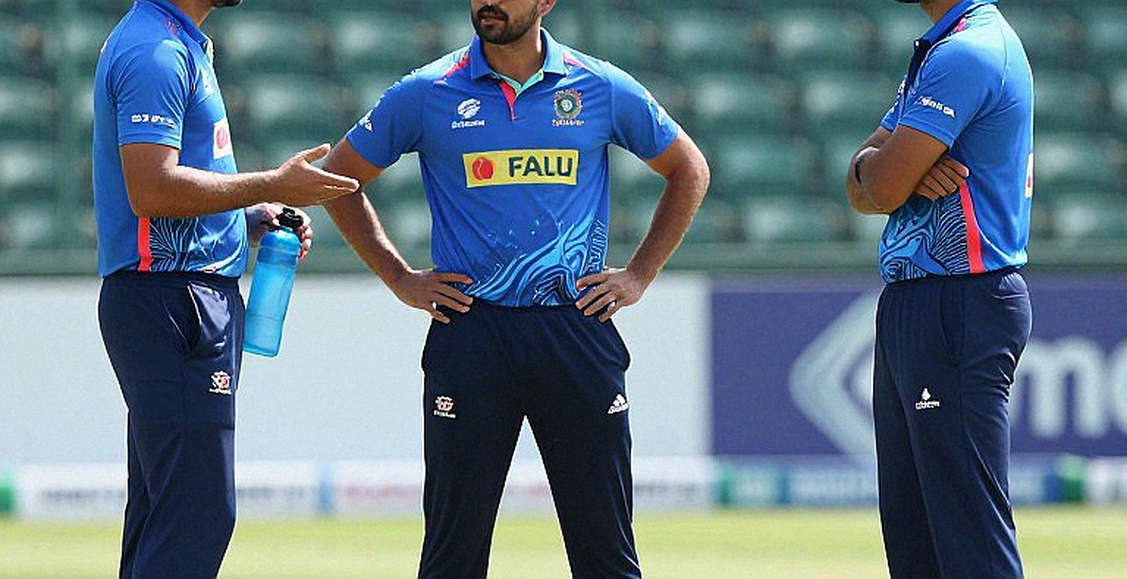
The first structural truth is that 5 for 4 did not merely spoil a start; it rewrote the batting card. A number seven who walks in at three down effectively bats as a number four, with twelve or fourteen overs ahead instead of the four to six his preparation assumes. Azmatullah Omarzai walked into exactly that situation. A captain at 5 for 4 is not defending; he is covering. Asking a number seven to bat twelve overs is a forced move, and calling a forced innings evidence of team depth is a misreading of the data.
Look at the shape of the innings: 116 off 50 balls, strike rate 232.0, twelve sixes, a maiden T20I hundred off 44 balls. Twelve sixes is 72 runs struck over the rope alone. The report also notes he left the hat-trick ball — a batter going at 232 choosing to leave one is the most technical detail in the innings. The finisher who succeeds at the death is not the one with the fastest hands; he is the one who can make a ball a spine, so the next ball has a position.
On a ground with short square boundaries, a captain with five wickets down has two options: keep sweepers out and concede singles, or crowd the infield and risk fours. Zimbabwe chose the second and 176 came in ten overs. The choice was not wrong in principle — attacking a side five down is logical when you are out of ideas. But Sharjah's geometry makes it expensive, because the square boundary is short and the ball clears midwicket. Soft ball, short boundary, set batter: the dot ball becomes the most valuable delivery in the bowler's repertoire. The report does not say how many dot balls were bowled. That is the blank box that would draw the real picture.
The Omarzai–Ijaz Ahmad Ahmadzai stand added 142, the highest for the sixth wicket or lower in T20I history (source: match report). Ijaz made 52 off 27 at 192.6, his second consecutive fifty after one in the series opener. The report mentions the ramp and the scoop past the keeper, which suggests a batter who uses the depth of the crease. But two innings is not a player's form; it is a hypothesis. Ijaz needs five to ten T20I innings, especially against sides who can sustain new-ball pressure.
Sixty-five runs in three overs is an average of 21.6 per over, enough to indict Zimbabwe's death bowling and not enough to explain it. Matigimu, who bowled a double-wicket maiden in his second over, went expensive at the end; Brad Evans conceded 27 in his last over. That is not a gap in ability; it is a gap in role. New-ball seam depends on movement and length; death bowling depends on yorkers, slower balls and reading a batter's reach — three separate skills. A system that files all three under 'fast bowler' will always produce one over worth twenty-plus.
Now the chase. At ten overs Zimbabwe were 82 for 5, needing 140 from 60 balls, which is 14.00 an over. Sikandar Raza made 106 not out off 56 at 189.3 and became the oldest man to score a T20I hundred at 40. His unbroken stand with Tsiga was worth 120. Here is the arithmetic the broadcast skipped: 120 runs in ten overs is 12.00 an over, against a requirement of 14.00. Even the great partnership, for all its volume, ran two runs per over behind the asking rate. The match was not lost at the death. It was lost in the first ten overs.
One more inference, with its limitation stated: 106 of those 120 runs came from one bat. That means limited strike rotation at the other end — Tsiga's job was survival, which is understandable at five down and fatal at a required rate of 14. The source does not give Tsiga's exact score, so I will not invent a number; the gap between the partnership total and the individual score is signal enough. Partnership quality in a chase is measured by how the strike is shared, not by the runs.
Rashid's 200th T20I wicket is a durable milestone, ten years of continuity rather than one match's output. His 25 off 6 is a cameo, and treating a cameo as evidence of technical change is the mistake every tournament repeats. Mujeeb ur Rahman, Fareed Ahmad and Abdollah give Afghanistan spin-pace variety, but the bowling detail in this match is incomplete — Omarzai took Innocent Kaia's wicket, the rest of the economy is unstated. So 'Omarzai is now an all-rounder' is premature. In a match where a man makes 116, his bowling figures get the least attention; that is the oldest habit of the selection system.
What the model cannot see should be written down: toss, dew, pitch report, field placements, Omarzai's bowling workload, injury history, dressing-room politics. None of it is available here. A conclusion from a one-match sample is statistically thin, and that is most true of innings that break records — a record is an outlier by construction.
The story the broadcast will tell is two centuries, a thriller, a 19-run margin. But that margin flatters Zimbabwe. A side needing 22 off the last over with five wickets in hand did not lose the match at the death; it had already lost it. Zimbabwe did not lose a single wicket in the last ten overs and still did not reach the target. The cause of defeat was the powerplay and middle-order collapse, on the same day Afghanistan were themselves 5 for 4. Both sides had the same disease. One had Omarzai; the other had only Raza.
Be honest about Raza's innings. 106 not out off 56 at 40 is extraordinary and deserves praise. But its impact depends on the moment it began: at ten overs, five down, at 14 an over. High skill, capped leverage. I am not calling it worthless; I am saying the phrase 'match-winning innings' here comes from feeling, not from data. The age curve is present too — a century at 40 can be a peak, not a direction. Zimbabwe's real worry is not what Raza does next; it is whether anyone else can carry 82 for 5 to 222.
Calling Afghanistan's win 'lower-order depth' is the most attractive and most misleading reading. Being cut at sixteen taught me something that applies to every system: a team winning from number seven is telling you nothing about numbers one to three except that something is broken there. 5 for 4 is not an accident; it is the first sample of a pattern. Against a stronger new-ball attack that becomes 30 for 5, and there is no room for a hundred off 44. Sharjah's short boundaries make the rescue possible; Melbourne and Lahore do not.
Zimbabwe's death bowling is easy to file as a skill deficit. Matigimu's opening maiden and his closing cost in the same match suggest a planning problem. A coach sees the error; a commentator sells it. I try to do the first — and the error is asking the bowler who was good with the new ball to bowl the twentieth over. When your only two death specialists have to be used in the sixteenth, the twentieth will be bowled under pressure by someone else. That is selection structure, and it returns next match.
One run at Gahunje is still the cleanest proof that systems fail late: you can be right for 39 overs and lose everything in the 40th. Zimbabwe's system had failed by the tenth, and ten good overs afterwards coloured the failure. Cricket analysis keeps mistaking the last scene for the first cause.
Three things to check in the third match. Afghanistan's powerplay — another sub-40 score with two or more wickets down makes 221 the exception, not the rule. Omarzai's four overs — whether he bowls a full quota decides whether 116 belongs to an all-rounder or a finisher. Zimbabwe's economy from overs 16 to 20 — if it stays above 10, the problem is structural, not personal.
And a fourth thing no scorecard will show: Raza is 40 and he is Zimbabwe's entire middle-order plan. On the day he does not play, 82 for 5 becomes 50 for 6. Afghanistan have Omarzai and Rashid; Zimbabwe have one man and one age. Next time these sides meet, watch the fourth over before you watch the score.