
India vs England, Match 4: Rotated India Begin Campaign Against England in Ahmedabad
भारत और इंग्लैंड के बीच कॉमनवेल्थ कबड्डी चैंपियनशिप 2026 का चौथा मैच अहमदाबाद के इनडोर स्पोर्ट्स कॉम्प्लेक्स में खेला जाएगा। यह भारत का पहला मैच है, टूर्नामेंट का चौथा। भारतीय टीम की कमान सुरजीत सिंह और उपकप्तानी नवीन कुमार के पास है। भारत ने प्रमुख खिलाड़ियों को आराम देकर युवाओं को मौका दिया है। ईरान और चीनी ताइपे इस आयोजन में नहीं हैं, इसलिए मैदान की प्रतिस्पर्धात्मक गुणवत्ता कम है। भारत फेवरेट है, लेकिन बड़ा अंतर उसकी असली ताकत का सटीक माप नहीं होगा।
Ahmedabad: The fourth match of the Commonwealth Kabaddi Championship 2026 will be played tonight between India and England at an indoor sports complex in Ahmedabad. For hosts India, this is their first match of the tournament, while it is the fourth match of the overall event. This distinction matters: India are beginning their campaign, but the championship has already seen three matches.
The most consequential competitive information around this fixture is India's team selection. The management has rested key players and handed opportunities to several young talents. This means India will be evaluating not merely the margin of victory but the depth of their bench and the tournament-readiness of their youngsters. The approach is effectively a talent audit, where the more important question is how many new caps look stable under pressure rather than what the scoreline says.
Surjeet Singh will lead the Indian side, with Naveen Kumar as vice-captain. The pairing suggests a deliberate structure: experienced leadership around an experimental pool of raiders and defenders. However, names such as Surjeet Singh and Naveen Kumar are shared by multiple players in Indian kabaddi. Any claim about their exact role or form should therefore be read cautiously unless a state or franchise affiliation is clearly stated.
Naveen Kumar's appointment as deputy is significant because the raiding load is likely to concentrate on him. With leading raiders rested, the team's scoring focus may narrow to one individual. That could increase, rather than reduce, single-point dependence compared with a full-strength side. His raiding efficiency and his decision-making in do-or-die raids against England will be worth watching.
For the young players, this is a major opportunity, but it comes with a caveat. England are not close to India's level, so a strong performance here does not prove that a young raider can handle a deep defence like Iran's or elite tacklers. This match is a step in the development process, not a final examination.
England's men's programme is built largely on the British Punjabi diaspora. Its international record is limited, and it sits below teams such as Iran and South Korea. England's realistic aim will be damage limitation and avoiding an early all-out cascade rather than winning. If they concede points in clusters early, the match could become one-sided quickly.
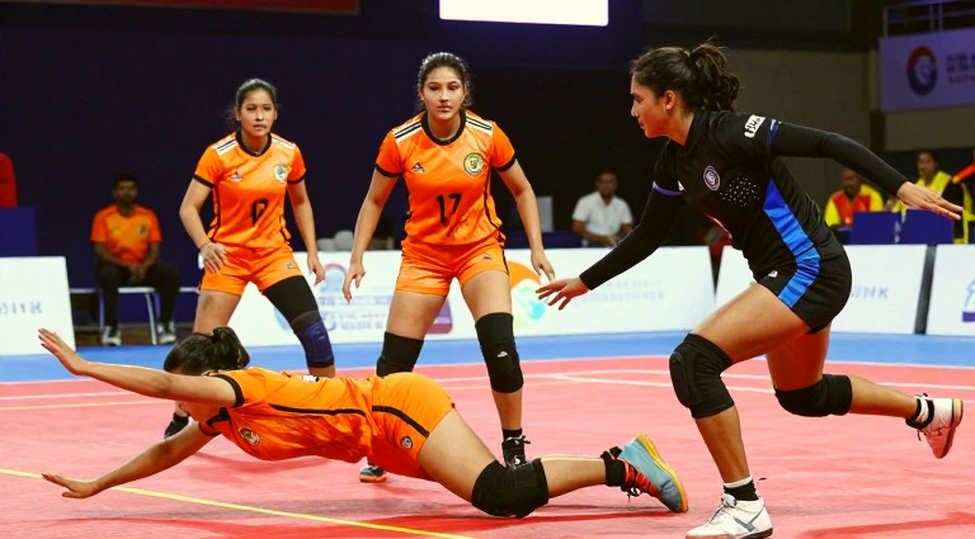
A brief understanding of kabaddi's rules is useful for reading this match. The court is 13 metres by 10 metres, with seven players a side. The raider crosses into the opponent's half within 30 seconds, scores by touching one or more defenders, and must return to his own half for the point to count. Throughout the raid he must chant 'kabaddi, kabaddi' continuously; if the chant breaks, the raid is void.
Defenders score through tackles. Stopping, holding or bringing down the raider in their own half constitutes a tackle. The bonus line lies deep in the opponent's court; when the defence has six or more players, the raider can earn one point by crossing it. An all out occurs when every player on one side is out; the opposition gets two extra points and the entire team is revived.
The do-or-die raid and super tackle add to the drama. After two consecutive empty raids, the third raid must produce a point or the raider is out. A super tackle occurs when the defence has three or fewer players and still completes a tackle; it is worth two points. These rules make kabaddi a fast-scoring game with frequent swings.
The key analytical warning for this match is that mechanisms such as the all out and the bonus line favour the stronger side. Against a weaker team like England, Indian raiders can accumulate touch points quickly and force repeated all outs. Each all out gives India two extra points, so the final margin can overstate their true strength. A big win should not be treated as a precise measure of India's level.
Similarly, the bonus line can inflate individual statistics. Crossing into deep positions against a full seven-man defence is not technically difficult, but it makes a raider's numbers look impressive. For evaluating India's young side, this is an important caution: statistics from this tournament should not be compared directly with Pro Kabaddi League or top-level international numbers.
The available source provides no raid points, successful raid percentage, tackle percentage or form data for any player. That means any pre-match claim is based on probability, not evidence. India are being described as favourites, but no metric supports the assertion. Readers should apply the same scepticism to sensational post-match reactions.
The tournament landscape raises another major point: Iran and Chinese Taipei are absent. Both are regarded as India's major challengers. Iran are the leading challenger in men's kabaddi, while Chinese Taipei are strong in the women's game. Their absence lowers the competitive quality of the field. India may find it easier to win the title, but this event is not the benchmark of their true strength.
The 'Commonwealth Kabaddi Championship' label also warrants caution. Kabaddi is not part of the Commonwealth Games, and this championship is not an established top-tier property on the level of the Asian Games or the IKF World Cup. The source does not clarify the sanctioning body, the event's history or which rulebook edition applies. In such events, the marketing value of the 'international' tag often exceeds the competitive value.
The real benchmark for India's strength is the Pro Kabaddi League, not this event. PKL brings together the world's best raiders and defenders, whereas several teams here are semi-professional. Comparing young players' performances in this tournament directly with PKL numbers would therefore be misleading. The right question is how they make decisions under pressure, not how many points they score.
Kabaddi is among India's most-watched sports after cricket, and it is also a vehicle of social mobility for young people from rural, low-income families. PKL contracts, railway, police and army jobs, and television coverage have turned the sport into a livelihood pathway. 'Giving young talents a chance' is therefore not just a team note but a social story that Indian media naturally amplifies.
England's participation gives the event an international sheen. Punjabi communities in Britain, Canada and Australia are deeply connected to kabaddi, and the 'Commonwealth' label is a way of reaching those audiences. That is a commercial logic, not a competitive one. England's level reflects its community roots; it is not a fully professional national programme, and its performance should be read in that context.
The hosting dimension also matters. The choice of a multi-sport complex and indoor arena in Ahmedabad reflects both spectator convenience and the television product. Gujarat has been ambitious about hosting sports events, and such championships fit a state-branding agenda. It is also worth noting that this report makes no reference to a women's team or women's competition, a significant gap in kabaddi's commercial packaging.
From a broadcast and media perspective, this match is primarily a 'where to watch' and live-streaming story. The source names no official broadcaster, platform or channel, which itself signals the event's limited commercial value. Viewers should confirm official tickets and streaming links with the organisers, as unauthorised links and fake streams are common.
The things to watch are clear. First, how quickly India's young raiders produce their first touch against England's defence. Second, how vice-captain Naveen Kumar handles the scoring burden. Third, the cohesion of India's corner and cover defence, because tackling technique is tested even against weak opposition. Fourth, how long England can avoid an all out and keep the match competitive.
The conclusion is that this is a development fixture for India, not a real test. The margin may be large, but it will not reveal India's global standing or the ceiling of their youngsters. The real evaluation will come against a team like Iran or when these players are tested under top PKL pressure. Until then, Ahmedabad is a beginning, not a verdict.
संबंधित खिलाड़ी
अनुशंसित
Kabaddi's Ledger: Raid Success Rate, Auction Premium, and the Empty Slot Where a Women's League Should Be2026-10-24
Kabaddi's Injury Register: A Blank Sheet, and the Entire Story Hidden Inside It2026-10-24
Thirteen Teams, One Contender: What Pakistan's Commonwealth Kabaddi Withdrawal Really Tells Us2026-10-29
Thirteen Names on the Ahmedabad List: The Questions No Camera Asked After Pakistan Pulled Out2026-10-26
Kenya vs Singapore at 11 AM: The Commonwealth Kabaddi Championship's Most Important Match Is the One Nobody Will Preview2026-10-23
Surjeet Singh Captain, Naveen Kumar Deputy: Two Names and Blank Pages in the Ahmedabad Announcement2026-10-29
Commonwealth Kabaddi Championship in Ahmedabad: 23 teams, 62 matches, and India's real test is the schedule2026-10-23
Six Hundred Do-or-Die Raids and Kabaddi's Hidden Crisis2026-10-24
अनुशंसित
Rs 5 Crore Auction and 10 Teams: The PKL Broadcast Crisis Hidden Behind Haryana's Kabaddi Champions League2026-11-04
Kabaddi's Injury Register: A Blank Sheet, and the Entire Story Hidden Inside It2026-10-24
Fourteen to Thirteen: Pakistan's Withdrawal Exposes the Real Question Beneath the Commonwealth Kabaddi Championship2026-10-23
First Commonwealth Kabaddi Championship in Ahmedabad: Before the 2030 Dream, Kabaddi Must Prove Itself2026-11-04
Kabaddi: From Clay Courts to the Global Stage — The Reinvention of a Sport2026-11-03
Commonwealth Kabaddi Championship 2026: Surjeet Singh Captain, Naveen Kumar Deputy — and Iran Is Not in the Field2026-10-23
Surjeet Singh Captain, Naveen Kumar Deputy: Two Names and Blank Pages in the Ahmedabad Announcement2026-10-29